

Wake Up with the Sun: Automating Your Bedroom Roman Shades for Better Wellness
A loud alarm can get you out of bed, but it rarely leaves you feeling steady. Light does a different job. Our bodies run on circadian rhythms, and daylight is one of the strongest cues for when to be awake and when to feel sleepy. Experts often recommend getting natural morning light as part of a regular routine, even if that just means opening curtains soon after you wake.
Automating bedroom Roman shades turns that idea into something you do without thinking. The fabric rises on a schedule, the room brightens gradually, and your brain gets a clear “day has started” signal before you reach for the snooze button.
Why morning light helps the body clock
Light influences the timing of hormones and other daily processes. Mistimed light exposure are often linked with disrupted circadian timing, while morning sunlight tends to pull the clock earlier and support more regular sleep.
At night, the problem flips: Harvard Health notes that blue-heavy light suppresses melatonin for longer than other colours and can shift circadian rhythms.
In an ordinary bedroom, a long, dark morning can delay that daytime signal. Automated shades can make morning light predictable, even on busy days.
What automation changes in day-to-day life
Motorised Roman shades shine when you want reliability. You can program a partial lift 15 to 30 minutes before your wake time, then open further at wake time. Many systems also offer sunrise triggers, which helps as seasons change.
The effect is subtle. The room shifts from dark to dim, then to morning brightness. For plenty of people, that reduces the harsh jump from sleep to waking.
Choosing Roman shades for a wellness routine
Roman shades in Los Angeles suit bedrooms because they look calm and tailored, and they can be lined for privacy and insulation. If you want a sunrise routine, focus on three choices.
- Fabric and lining: Dim-out fabrics soften early light while keeping privacy. Full blockout works well for shift workers or very light sleepers, but a staged open usually feels nicer.
- Fit and light gaps: Inside-mount shades often reduce side light spill. Outside-mount shades can cover more area and suit shallow reveals. Either can work; decide whether you want a bright “start” or a gentle glow.
- Power and controls: Battery motors suit many retrofits and avoid new wiring. Hardwired motors reduce charging and can be better for daily movement.
Programming a routine that actually sticks
Start small and adjust. A 10–20% lift before wake time is enough for many rooms, followed by a larger open once you’re meant to be up. Winter mornings can still feel dim.
The US CDC notes you do not need continuous exposure for morning light to be useful, and intermittent exposure may be enough. So, keep the routine, then step outside briefly when you can.
There are side benefits. Closing shades before a hot afternoon can reduce glare and unwanted heat. Motorisation also supports cordless designs, removing dangling cords that can be risky around children and pets.
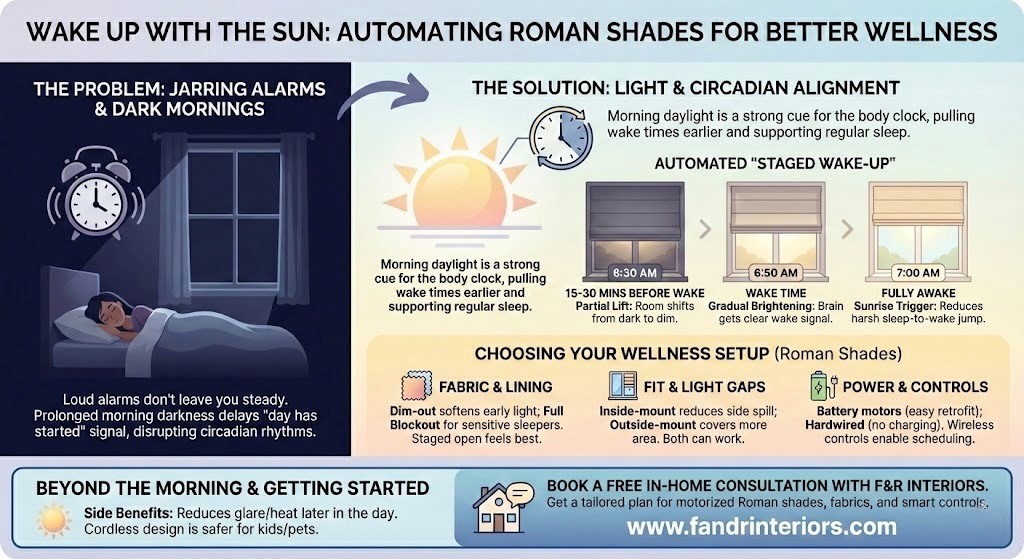
Book a free in-home consultation with F&R Interiors and get a tailored plan for motorised Roman shades that suits your sleep routine and your room. If you’re also comparing custom blinds in Los Angeles, speak with their design consultants about fabrics, linings and smart controls, then arrange measure and installation in one smooth process.
Also Read: How Roman Shades Can Help Cut Heating Costs This Winter
Frequently Asked Questions:
1) Are motorised Roman shades a good alternative to a sunrise alarm clock?
Often, yes. A sunrise alarm uses a lamp, while automated Roman shades bring in daylight, which sleep educators commonly recommend as a strong morning cue.
2) How do I automate Roman shades to open at local sunrise?
Choose a motor with sunrise scheduling (an astronomical timer) or connect the shades to a smart-home hub that can run a sunrise routine. A staged open is usually more comfortable than a full open.
3) Can automated bedroom blinds help with morning grogginess?
They may help by easing the transition from sleep to wake. Bright light at night can delay sleep timing by suppressing melatonin, so reliable morning light plus dim evenings is a practical mix.
4) Are smart blinds and motorised shades safe for kids and pets?
Cordless coverings are generally safer because they remove pull cords. Motorised shades are typically controlled by a switch, remote, or app. Ask where batteries sit and how remotes are stored.
5) Do automated Roman shades save energy in Australian homes?
They can contribute, though results vary. Closing shades during peak summer sun can reduce solar heat gain, while opening them in winter mornings can let warmth in. Orientation and glazing matter most.
If you have ever fallen into an online rabbit hole of shades in Los Angeles, it is worth coming back to the core point: your bedroom light can work with your sleep, not against it. Automated Roman shades make morning daylight reliable, which is a small change that many people feel every day.